

War Is the Best Time to Trade — Here Is Why

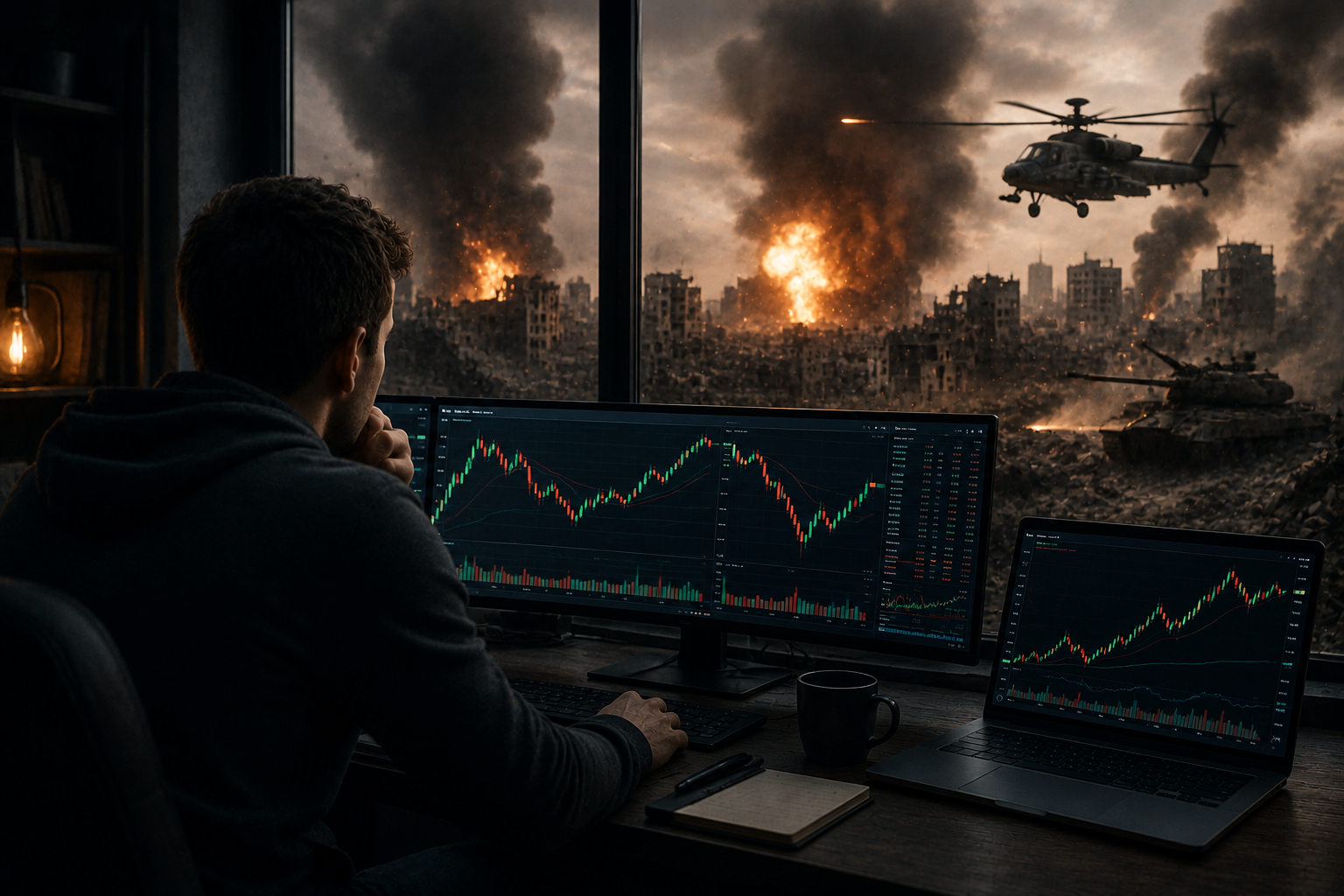
On 24 February 2022, Brent crude broke above 100 dollars for the first time since 2014, gold pushed toward 1,976, and European indices opened deep in the red. By the close of that same session gold was negative and the Nasdaq had finished more than three percent higher.
One day. Three completely different directions. And thousands of traders who blew up accounts while being entirely right about what was happening in the world.
That is the catch buried in the headline. War genuinely is the period when markets hand you the most movement per unit of time. It is also the period when most people lose money. The gap between those two outcomes has almost nothing to do with how well you understand the conflict.
Markets do not trade news, they trade the gap between expectation and reality
The price of any asset at any moment already contains everything the market expects to happen. When troops move toward a border weeks before an operation begins, oil and gold are already moving. By the time the operation is officially announced, most of that risk has been paid for.
Which is why something that looks absurd to an outsider happens over and over: a war breaks out and the asset that is supposed to rally goes down.
On the night of 17 January 1991, as Operation Desert Storm began, crude lost roughly a third of its value in a single session. Not because war is good news, but because for weeks the market had been pricing a far worse scenario: severed supply, burning fields, a closed Strait of Hormuz. The moment the unknown became known, the risk premium drained out like air from a punctured balloon.
The same mechanism repeated during the exchange of strikes between Israel and Iran. The first hours were vertical. The following days erased nearly all of it.
The old line about buying at the sound of cannons and selling at the sound of trumpets is not folklore. It is a fairly precise description of how risk premium accumulates in anticipation and evaporates in fact.
What wakes up, and in what order
The reaction is almost never simultaneous. There is a hierarchy, and it has repeated for decades.
- First to move, especially when the conflict sits in or near a producing or transit region. The move is fast and often reverses within days.
- Safe havens. Gold, Swiss franc, US dollar, Japanese yen, long-dated government bonds. The move here is shallower than people expect and exhausts itself quickly.
- Defence names. They react within hours, but the real repositioning comes with budget announcements, not with the outbreak of fighting.
- Agriculture and fertiliser. Wheat, corn, ammonia. Slower to respond, but more durable, because actual supply chains are being rewired.
- Currencies of neighbouring economies. The most violent and the least liquid move on the board. The largest sums are made and lost here.
- Broad indices. Usually the last to fall and the first to recover, unless the conflict threatens global growth or the rate path.
The hidden bill nobody posts about
The chart you look at afterwards is clean. The reality during the move is not.
Spreads widen by multiples. A position that normally costs you one pip suddenly costs fifteen. Execution lags. Your stop does not fill where you placed it, it fills where there is opposing liquidity, sometimes far below.
Brokers raise margin requirements, often without warning and at the worst possible moment. A position that was perfectly ordinary on Friday needs twice the collateral on Monday. Markets gap over the weekend, when there is nothing you can do about it.
And the part most traders miss: the volatility that makes the move attractive is the same volatility that makes your usual position size dangerous. Trading your normal lot into a range four times wider than average means you have quadrupled your risk without ever consciously deciding to.
The second move is the better move
The first reaction belongs to the algorithms. They parse the headline in milliseconds and position before you have opened your platform. You cannot beat them and it is not worth trying.
The second move is human, and that is the tradable one. It arrives when the initial panic meets reality: supply was not cut, central banks respond, diplomacy engages. That is when you find out whether the move has a foundation or was pure reflex.
In practice this means waiting for the first few hours to close, watching whether price holds the level it jumped to, and trading the confirmation rather than the headline. You give up part of the range. In exchange you get liquidity, normal spreads, and the ability to place a stop that actually means something.
If you do decide to participate in the first wave, the only sane adjustment is a drastically smaller size. Half a position into a move ten times larger than usual is still more risk than a full position on an ordinary day.
A line worth keeping clear
Something should be said plainly here. These moves on the chart reflect real events in which people lose homes and lives. A market is a mechanism for repricing risk, and it works whether or not we approve of it. Understanding that mechanism is not cynicism. Celebrating it is.
The practical side of this is not moralising. A trader who reacts emotionally to the news trades worse. One who treats it as a change in expectations and in liquidity makes colder, better decisions. That distance is not coldness, it is part of the craft.
What actually holds up
War is not the best time to trade because it hands out easy money. It is the best time because within a few days it compresses lessons that a normal market takes years to teach: how spreads behave under stress, what happens to your stop when liquidity thins, how quickly a risk premium burns off, what it costs to trade a headline instead of a level.
Manage your size, wait for the second move, and accept that part of the best possible action is not participating at all, and these periods can genuinely be the most productive of your year. Walk in with your usual lot and a conviction that you know where the world is heading, and you will learn the same lessons at a much higher price.
This article is educational and does not constitute investment advice. Leveraged trading carries a high risk of capital loss. Do not trade with money you cannot afford to lose.