


CFD trading: what it actually does to your money, and where to start

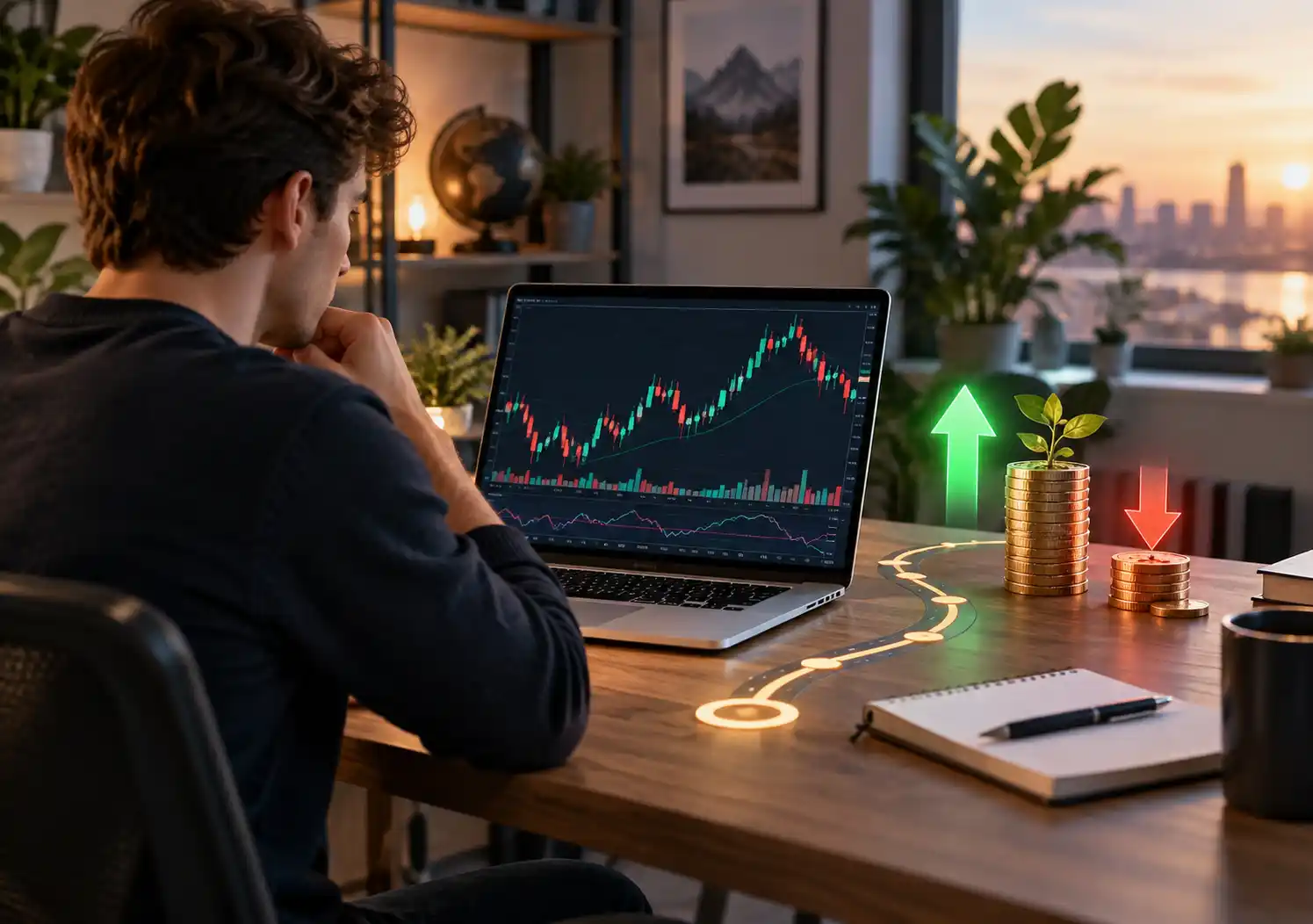
CFDs are the most accessible way for a retail trader in Europe to get exposure to gold, oil, US indices and currencies from a phone. That's a fact and there's no point pretending otherwise.
CFDs are also a product where the European regulator established that between 74% and 89% of retail client accounts lose money, with average losses per client ranging from €1,600 to €29,000. That's also a fact.
Both sentences are true at the same time. This article isn't here to sell you on either one. It's here so you understand the instrument well enough to make your own decision.
What a CFD actually is
CFD stands for contract for difference. You enter a contract with your broker to exchange the difference in an asset's price between the moment you open the position and the moment you close it.
The key point: you never own the asset. You aren't buying gold. You aren't buying a share of Apple. You receive no dividend and you can't take delivery. You hold contractual exposure to a price movement and nothing else.
Three practical consequences follow:
- You can open positions in either direction just as easily — buying and selling are symmetrical operations.
- You can take exposure to $430,000 of an asset without having $430,000.
- Your counterparty is the broker, not the market. Which is why who the broker is, and who regulates them, matters.
Leverage: the only thing you genuinely have to understand
Everything else in CFD trading is detail. Leverage is the substance.
Concretely. Gold trades near $4,300 an ounce. One standard lot is 100 ounces, so a notional value of roughly $430,000. At the maximum permitted leverage for gold in the EU — 20:1 — required margin is 5%, or about $21,500.
So $21,500 controls $430,000. If gold moves 1%, that's $4,300 — 20% of your margin. An ordinary day's move in gold becomes a fifth of your deposit.
Up and down. In exactly the same way.
Leverage doesn't make a market more profitable. It makes time shorter. The same percentage error that would cost you months unleveraged costs you an afternoon on margin.
Which is why the real question with CFDs isn't 'what's my profit,' it's 'how much does this instrument move in a day, and what share of my account is that move.' If you can't answer the second question before opening a position, don't open the position.
The EU rules, and why they exist
After analysing actual outcomes across retail client accounts, the European regulator ESMA introduced measures that apply across the EU. They're worth knowing, because they're the most honest document about this product you'll ever read.
Maximum leverage on opening a position by a retail client:
- 30:1 for major currency pairs
- 20:1 for non-major currency pairs, gold, and major indices
- 10:1 for commodities other than gold and for non-major indices
- 5:1 for individual equities
- 2:1 for cryptocurrencies
The rest of the measures:
- Margin close-out at 50% of required minimum margin — the broker must close positions once the account drops below that threshold.
- Negative balance protection on a per-account basis — you cannot end up owing your broker money.
- A ban on bonuses and incentives to trade CFDs.
- A mandatory risk warning on every advertisement, stating the specific percentage of losing accounts at that specific provider.
Read that last point again. There's no other financial product in the EU legally obliged to tell you, at the door, what percentage of its clients lose. That isn't an accident.
The costs people forget
Most beginners assume the spread is their only cost. It isn't.
Spread
The gap between the bid and the ask. You pay it on every entry. If you're scalping ten times a day, the spread is your dominant cost and often the only one that matters.
Overnight swap
This is the cost that quietly kills swing traders. Hold a position past a set hour and you pay or receive interest on the full notional value, not on your margin.
In practice, long positions in a high-rate environment carry a negative swap almost every time, and on gold it's particularly noticeable. A position held for three weeks can cost you more than the trade was worth taking.
Weekend gaps
Markets close, the world doesn't. Your stop doesn't execute while the market is shut — it executes on the open, at whatever price is there. This is the one scenario where you genuinely lose more than planned.
The honest test: is this for you
Answer five things. If any answer is no, the answer to the big question is also no — at least for now.
- Could you lose your entire deposit without it changing anything in your life?
- Could you explain what margin is to a friend in two minutes?
- Do you know the average daily range of the instrument you want to trade?
- Do you have a written rule for your maximum loss per trade and per day?
- Are you prepared to trade for three months without expecting money?
Notice what's missing from that list. There's no question about predicting the market. No question about indicators. People don't fail at CFD trading because they can't read direction. They fail because their position size turns a normal mistake into a fatal one.
Where to start
- Pick one instrument. One. A major currency pair or gold makes the most sense, because they have liquidity, tight spreads, and predictable hours of movement.
- Learn its range. Record its daily range for two weeks. After that you'll know what counts as a stop and what counts as noise.
- Calculate position size backwards, not forwards. Start from the maximum loss in euro, divide by the distance to your stop, and that gives you the size. Never the other way round.
- Trade minimum size for at least a month. The goal isn't profit, it's finding out whether you follow your own rules when real money is involved.
- Log every trade. Without a log you have no data, and without data next year will look like this one.
It isn't a fast route, and that's precisely why it works more often than the alternative. CFDs are a tool — good in certain hands for certain jobs, destructive in others. Tools don't change lives. People who learn to use them properly sometimes change theirs.
This article is for educational purposes only and does not constitute financial advice. Trading financial markets and cryptocurrencies involves high risk – only invest money you can afford to lose.