


A Strategy Only Proves Itself After at Least 100 Trades

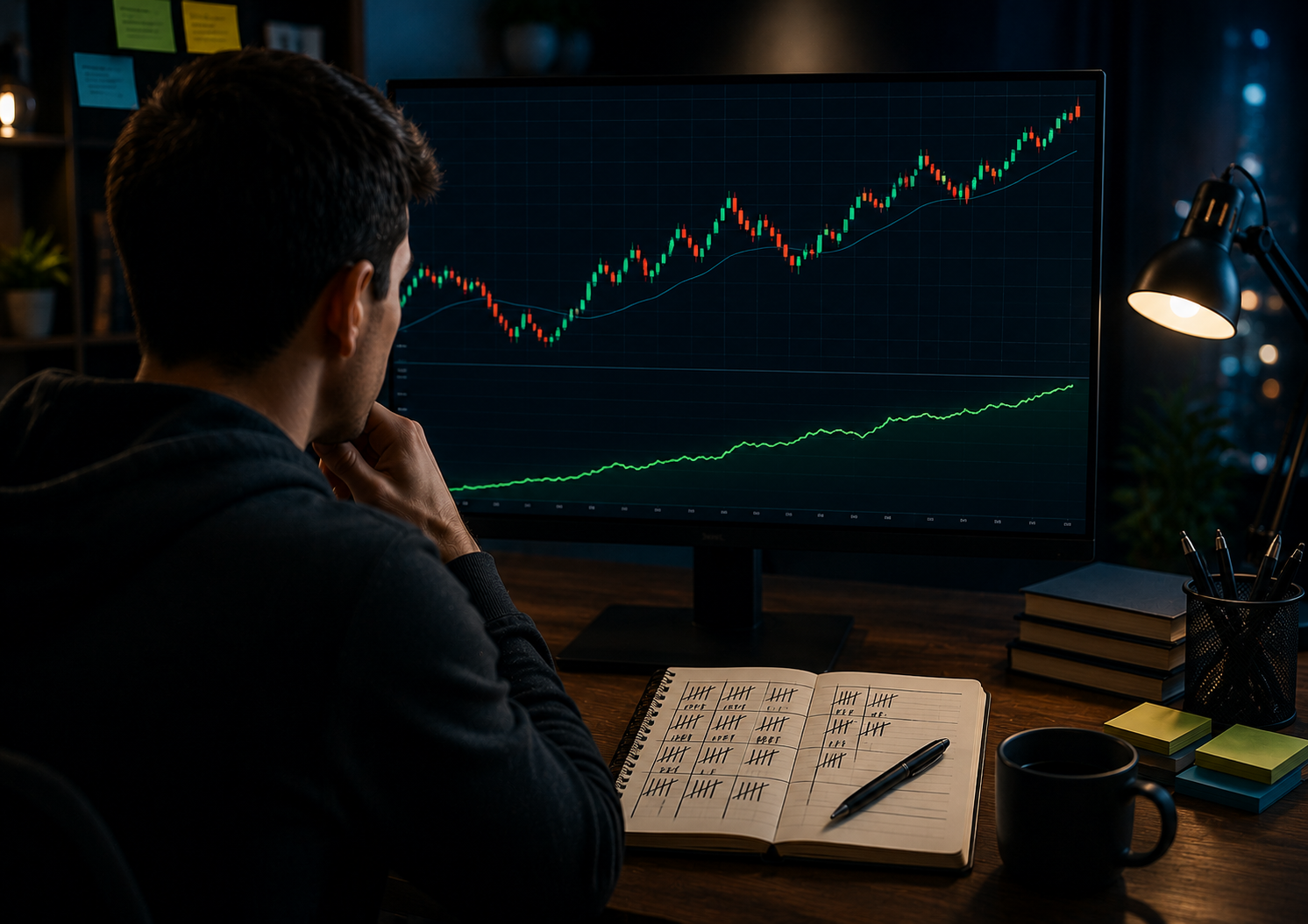
There's a moment almost every trader goes through — you find a strategy, test it on ten trades, seven of them win, and suddenly you're convinced you've found the Holy Grail. The problem is, ten trades prove absolutely nothing. It's a coin flipped ten times — and it's completely normal for it to land heads more than tails without that saying anything meaningful about the coin itself.
Why a small sample lies to you
The market is a random process with some underlying structure, not a guaranteed sequence of outcomes. With a small number of trades, luck weighs far more than the strategy itself — you could have a genuinely good system that happens to lose ten times in a row, or a bad one that happens to win ten times in a row.
That's exactly why ten, fifteen, or even thirty trades aren't enough to say anything meaningful about a strategy's real edge. Statistics simply need more data before the noise of randomness gets drowned out.
Why 100 trades specifically
The number 100 isn't magic, but it's a practical minimum at which results start telling a meaningful story. At that sample size you can see a real win rate, a real risk-to-reward ratio, and — most importantly — how the strategy behaves across different market conditions, not just one particular stretch of time.
On top of that, 100 trades almost always force you through several different market phases — trending, ranging, volatile — and a strategy that's only ever been tested in a trend tends to fall apart the moment the market's character changes.
What you're actually looking at after those 100 trades
You're not just looking at the bottom-line dollar result. What matters more is the win rate relative to the real risk-to-reward ratio, the maximum losing streak (this tells you whether you can psychologically stomach the strategy), and consistency — whether results are spread evenly or hinge on one or two spectacularly lucky trades.
If the entire profit comes from three incredible trades while the other 97 roughly cancel each other out, that's an important signal — it doesn't necessarily mean the strategy is bad, but it means you need to understand where the real edge is actually coming from before putting real capital behind it.
The patience most people don't have
Here's the uncomfortable truth — 100 trades take time. Depending on the timeframe, that could mean weeks or months of following the system with discipline, without abandoning it the moment you hit two losses in a row.
That lack of patience is exactly why most people switch strategies every few weeks instead of gathering enough data to figure out whether the problem is the system itself or simply how it's being executed.
Conclusion
Testing with a large enough sample isn't a bureaucratic formality — it's the difference between guessing and knowing. Until you've gone through at least 100 trades, any opinion about your strategy, good or bad, is still just an opinion. After that, you have data — and unlike the emotion left over from one great or one terrible week, data doesn't lie.