


Here’s How You Can Buy and Sell in a Sideways Market

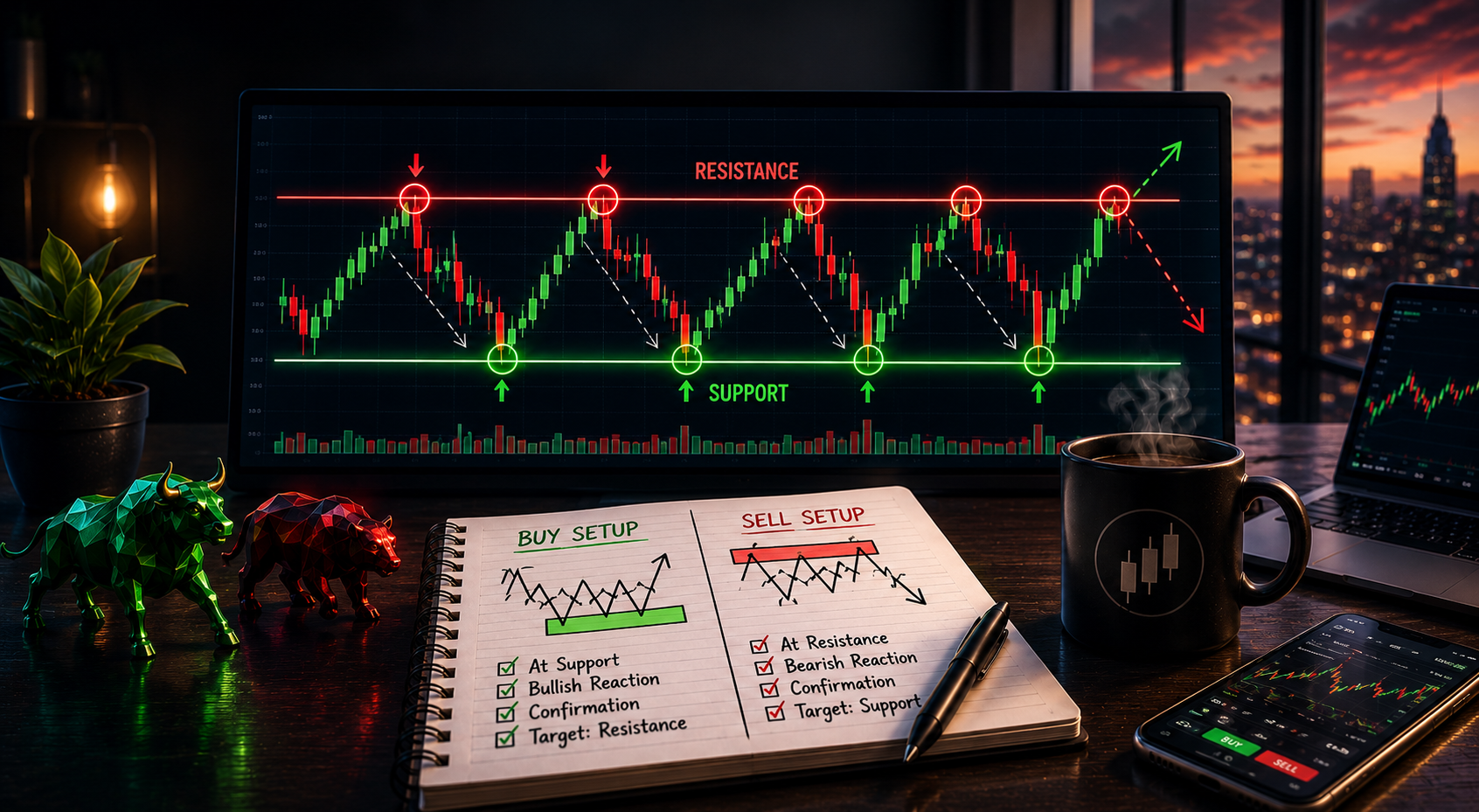
When the market is not going up or down, many traders get confused.
👉 “There’s no trend — so there are no opportunities”
The truth is the opposite.
A sideways market (consolidation) offers clear and repeatable opportunities — if you know how to use them.
1. What is a sideways market?
A sideways market means price is moving within a range.
You have:
- an upper boundary (resistance)
- a lower boundary (support)
👉 Price “bounces” between these two levels
2. The core idea
Instead of looking for a trend:
👉 you look for boundaries
The logic is simple:
- buy at the bottom
- sell at the top
And repeat.
3. When to buy
You buy when price is near the lower part of the range.
But NOT immediately.
Wait for:
✔ reaction (price holding)
✔ reversal structure
✔ confirmation
👉 You don’t buy because it’s “cheap”, but because there’s a reason
4. When to sell
You sell when price reaches the upper boundary.
Again:
✔ wait for a reaction
✔ look for signs of weakness
✔ avoid impulsive entries
5. The most common mistake
Traders often do the opposite:
❌ buy in the middle
❌ sell in the middle
❌ enter on false breakouts
👉 The middle of the range is the worst place to trade
6. What to do on a breakout
Sooner or later, the range will break.
But:
👉 the first breakout is often false
So:
✔ wait for confirmation
✔ don’t chase the move
✔ observe whether price holds outside the range
7. The advantage of this approach
A sideways market gives you:
✔ clear levels
✔ repeatable structure
✔ controlled risk
✔ less chaos
👉 This makes it perfect for building discipline
8. The most important rule
❌ Don’t trade everywhere
✅ Trade only at the zones
If price is:
- in the middle → do nothing
- at the edge → look for opportunity
Conclusion
A sideways market is not “bad”.
It is:
👉 predictable within the range
When you start thinking in levels instead of direction:
- your entries become more precise
- your mistakes decrease
- your risk becomes controlled
👉 And you begin to use the market instead of fighting it
This article is for educational purposes only and does not constitute financial advice. Each trader is responsible for their own decisions. Past performance does not guarantee future results.