


Here’s how our indicator helps you even if you know nothing about the market

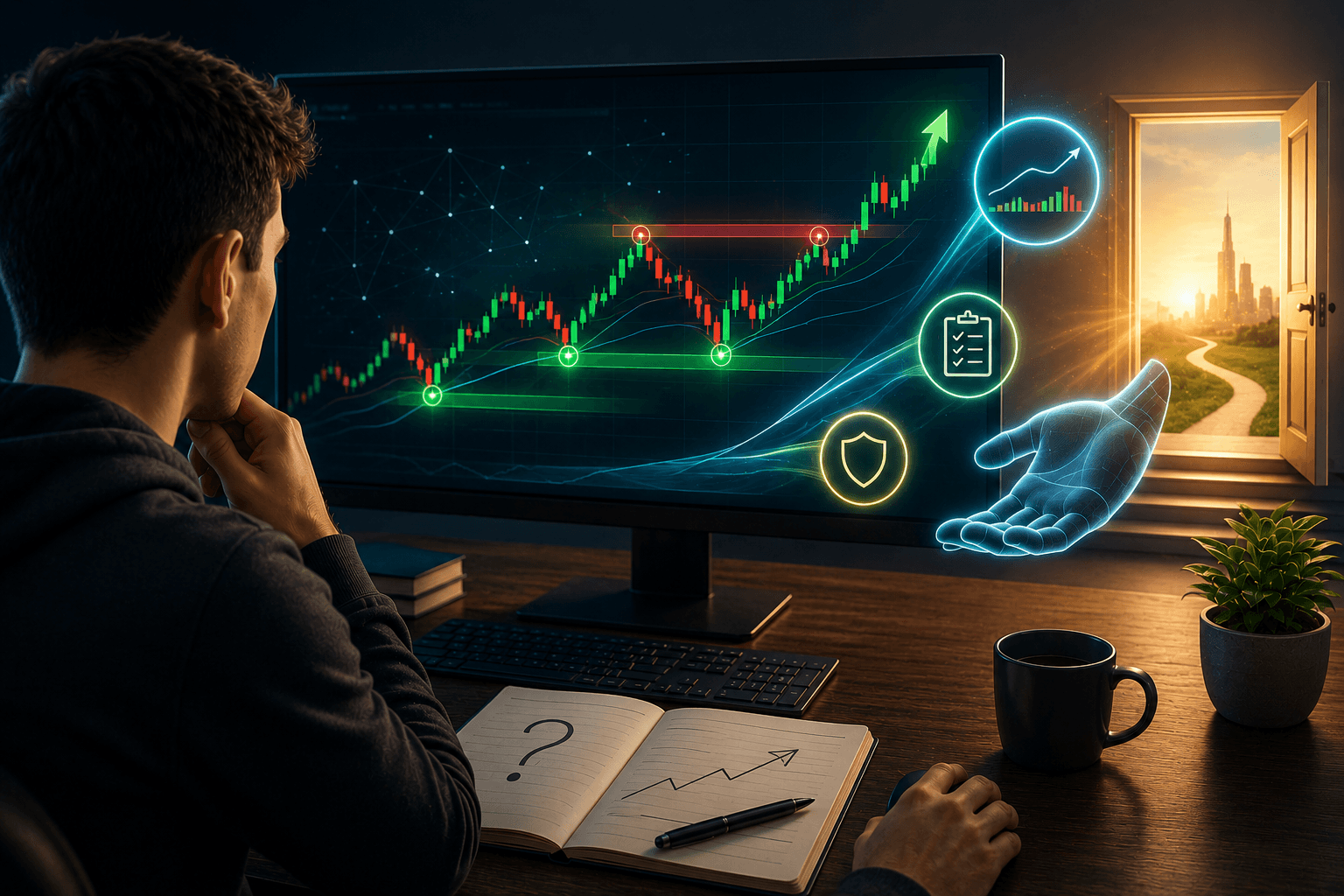
The first time you open a chart, it looks like noise. Red and green candles, dozens of lines, terms nobody bothers to explain. The reasonable reaction is to conclude you'd need two years of study before pressing a single button.
We approached the problem from the other end. Instead of making you learn everything at once, we built a tool that shows you the one thing that matters right now — and teaches you while you use it.
A beginner's real problem isn't a lack of knowledge
Anyone can learn what support and resistance are in twenty minutes. The problem is different: live, with real money on the line, you don't know what to pay attention to. You look at the chart and see ten possible scenarios at once. The result is either paralysis or an impulsive entry because it “looks like it's going up”.
Beginners don't lose because they lack theory. They lose because they lack a rule. And without a rule, every decision gets made on emotion.
What Institutional flow Dynamics does
The indicator reads the chart for you and puts three things in plain language:
- Direction — what phase the market is in and whether a trade is worth looking for at all.
- Entry level — a specific zone, not “somewhere around here”.
- Exit and protection levels — where you get out if you're right, and where you get out if you're wrong.
That last point is the one most people skip, and it decides whether your account survives. The indicator won't let you open a position without knowing in advance how much it can cost you.
What it looks like in practice
You open the chart. The indicator is already on it. When conditions aren't there, it stays silent — and that's part of its job, because most losses come from trades that should never have been opened. When conditions line up, you get a signal with the three levels above and a short explanation of why.
That “why” is the point. The goal isn't for you to press buttons blindly forever. After two or three months you start recognising the setups yourself, before the indicator marks them. At that stage it shifts from a crutch to a confirmation.
What the indicator doesn't do
We'll be blunt here, because this market is full of promises that don't hold up.
- It doesn't know the future. No tool does. It works in probabilities, not guarantees.
- It doesn't win every trade. Losing trades are part of every working system — what matters is that the losers are smaller than the winners.
- It doesn't replace risk management. If you risk half your account on one position, no indicator will save you.
- It isn't an automated bot. You make the decision — the indicator only narrows the options down to the sensible ones.
Who it's for
Someone with an hour or two a week, who wants to start without months of theory first, and who prefers a clear rule to intuition. If you've been trading your own system for years, this will be a second opinion rather than your main tool.